The Bigger Picture
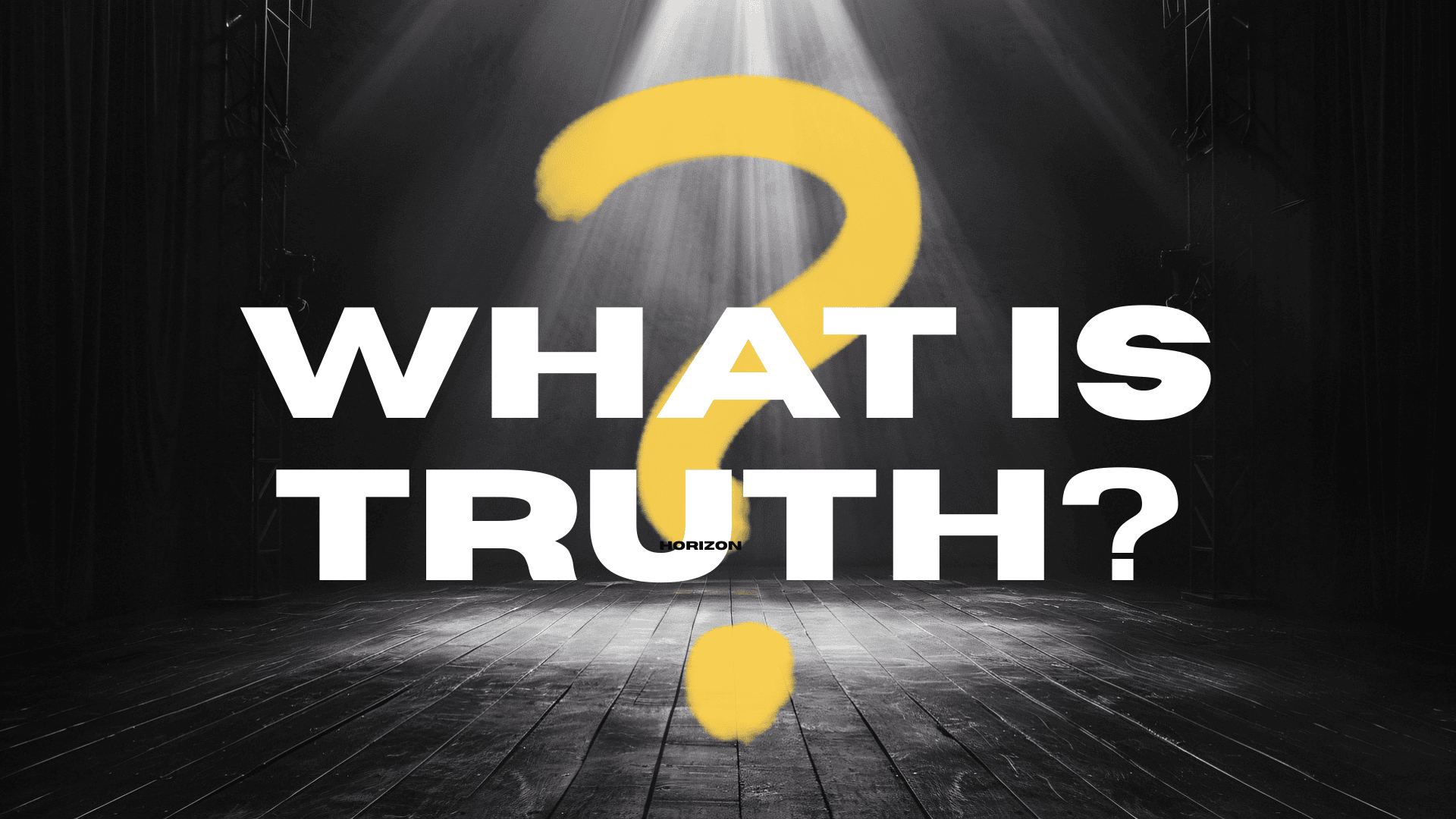
Is that really true?
It’s hard to know what the truth is these days. Sometimes I feel as if I’m the Velveteen Rabbit asking “What is REAL?” in perpetual replay.
Depending on what our news sources are, or what angle any given reporter might spin, we can read radically different views on a single event.
How do we know what we are reading is true?
Then there’s the whole AI photo/video thing. It’s becoming harder and harder to know what’s actually real and what is generated.
How do we know what we are seeing is true?
And don’t get me started on beliefs that, for so many people, are bricked up and reinforced into such a solid wall that there is no room for questions, let alone growth.
How do we know what we believe is true?
In the Narrative Lectionary reading this week about Jesus’s trial, Pilate’s question “What is truth?” reaches across the centuries and pinpoints our current crises.
I read that . . .
Never before has humanity had so much information available. Almost instantly. Something happens halfway across the world, and we can read about it within the hour—or within minutes, if it’s “breaking” news.
The internet has made “experts” out of us all. If we don’t know the answer to something, we google it. If we want more information, we google it. If I’ve got a mysterious pain, my first thought is to scour the internet to find out what it could be. I might come up with a lot of information. I might even think I’ve come up with some answers.
But my source limits my understanding: The internet is rife with misleading, conflicting, and false data. My pieced-together information pales in comparison to what a physician who has studied this stuff for years and been in practice for decades would know. Her understanding of what’s going would be far deeper than I could ever glean in a few searches.
My mind jumps back to the day I received my second diagnosis of breast cancer. I thought I “knew” the drill from my first go-round. But this time, a surgeon was telling me I needed to have a mastectomy.
Of course, I googled for more info. I read article after article, checking stories and opinions. By the time I thought I was thoroughly informed, I had convinced myself that not only was a mastectomy necessary, but that I should have a double mastectomy as a prophylactic measure. I was already planning how much time I would have to take off work and what kind of care I would need.
Fortunately, I decided to get another opinion. I found a breast cancer surgeon at Prentice Women’s Hospital in Chicago who was a specialist in lumpectomies and mastectomies. I remember well the conference room where I was sitting, with a friend by my side ready to help me absorb the information, when this amazing doctor came in and told me she didn’t think I needed a mastectomy, let alone a double one. She was confident she could remove the cancer with a simple lumpectomy.
When truth is limited to what we think we know, we might never know the bigger picture. We might never imagine a different outcome. We might never be open to new possibilities.
So I keep praying . . .
God of Infinite Knowledge,
open my mind
to previously unfathomed possibilities,
to surprising new ways of thinking,
to unexpected depths of understanding.
Expand my willingness to be pried off dead-center.
Stir the embers of my questions into an eagerness to know more.
I saw that . . .
There are plenty of adages that link “seeing” with “believing.”
How many times have you heard someone say, “I’ll believe it when I see it”?
Yet we all know that what we see can be distorted. Even before AI was everywhere, there were plenty of ways to modify visuals. For years, I used Photoshop, and I know all too well how easy it is to trick the eye into seeing something that’s not real.
When what we accept as truth is limited to what we can see, it’s a little like shining a flashlight onto one spot and seeing just a small stack of rocks. What the light of the flashlight doesn’t show us is that there are many more stacks ahead—cairns that others have built to mark the trail and provide direction. All we can see with a flashlight is what’s right in front of us, and we miss the bigger picture.
The same holds true when we look at other people. We see only a fragment of who they are, only what they are able or willing to share. A few years ago, a young adult novel caught some media attention because it was written by a sixteen-year-old girl. Falling into Place tells the story of a high school junior named Liz who tries to commit suicide by crashing her car. A flashback observation from the narrator laments that people only believed what they could see:
Out of the seven billion people sharing the planet with her, not one of them knew what was going through her head. Not one of them knew that she was lost. Not one of them asked . . . They only believed in what they could see. Appearances were all that mattered, and no one would ever care what she was like on the inside. No one cared that she was breaking apart.
—Amy Zhang, Falling into Place
This one hits close to home. During my senior year in college, I looked successful … from the outside. People could see that I was active, productive, president of what was then the Women’s Glee Club, and assistant director. But they couldn’t see how deep the cracks were that depression was carving inside of me, and how thin the glue was that was holding me together.
I knew I needed help, but it took a long time and a lot of courage to ask for it. Today, I can look back on that time and feel grateful that some people were there for me. But I also feel sad that it took me so long to let anyone know I was hurting. The truth is, we might not know how someone is feeling unless we ask.
There’s another section in Zhang’s book that capsulizes the mutuality of asking. If we want people to ask us how we are, we need to ask them the same. Then we need to be willing to share how we are and to receive what they share with us—and honor what they choose to keep private.
[Her friends] were worse than strangers. These were people she had spent years and years with and never even wondered about. She had never asked about their fears or failures, successes and embarrassments.
—Amy Zhang, Falling into Place
When truth is limited to what we see, we might never recognize a deeper truth. We might never ask, “What else is going on? What am I not seeing?” We might never feel the need to look beneath the surface to understand more.
So I keep praying . . .
O God of Expansive Vision,
open my eyes to see the unshed tears;
open my ears to hear the unspoken cries;
open my mouth to ask, ‘Where do you hurt?’
Help me share myself, and my needs, honestly
and invite the same from those around me.
I believe that . . .
We humans sure like our sureties. And we like to believe that what we believe is “right”!
I grew up in a very conservative, fundamentalist Christian home, and I was taught many things that were absolute. No questions asked. That’s what the Bible says. That’s what God says.
But as an adult, I began to question some of those seemingly rock-solid beliefs. Did creation really happen in six 24-hour days or is the creation story a metaphorical way of teaching us about the nature of God and God’s relationship with humankind? Were only people who said the exact words “I accept Jesus as my personal Savior” Christian? Were Catholics Christians? Was the Rapture really going to happen any day now? Where did the sacred wisdom of ancient traditions fit in?
Questioning a belief can be unsettling.
Yet, every day we continue to operate under the assumptions of what we believe, even in the most mundane of circumstances. If someone doesn’t show up for an appointment, we might believe that he or she forgot. Or that they had the wrong date. Or that something else had come up for them. We might even feel angry that they were a “no show” and didn’t let us know.
But what we believe is limited by the data at hand. We know only part of the story … and what we don’t know might be huge.
When I was in my late-thirties, my dad died suddenly of a heart attack. He had gone to his car in the garage of the apartment building where he and my mom lived, and had planned to head out for a breakfast meeting. A good Samaritan found him dead at the steering wheel. He never got out of the garage.
Later—much later—after I’d had time to process the shock of him dying so unexpectedly, it occurred to me to wonder about the person who had been waiting for him at that restaurant. When my dad was a no-show, what did this person believe? Did he assume my dad had forgotten? Or that something more important had come up? Or that my dad wasn’t reliable?
Such tiny assumptions in the face of one human tragedy.
If we are so quick to fill in the blanks with what we believe about each other, I have to wonder how quickly we fill in the blanks about what we believe about God.
In the story of Jesus’s trial, it seems as if Pilate were trying to discern who Jesus really was. He asked Jesus, “Are you the King of the Jews? What have you done?”
In our attempts to know who Jesus is, we might have a few questions of our own. But the real question is not so much what we believe, but what we are OPEN to believing. We might cling to what we “know,” but what we don’t know is unfathomable.
This week I saw a headline that read “How to Know God.” But then I read another headline that asked, “How Dare We Say That We Know God?”
From where I sit, to think we know God is NOT to know God. God is too big to fit into our thinking, even our imagination.
I think of Saint Augustine’s wonderful words, “If you have understood, then what you have understood is not God.”
Or Barbara Brown Taylor’s statement, “God exceeds all our efforts to contain God.”
The truth of who God is will always be a marvelous mystery. We’ll never know the full truth, nor should we. If we think of God in absolutes—this is right, this is wrong—we miss the bigger picture. If the only source of our “truth” is what we believe, we’ll never be able to expand our experience of the Divine.
I take to heart these words of Fr. Barnabas, a Greek Orthodox Christian priest:
We moderns are suspicious of mystery. It makes us uncomfortable. So we try to conquer it. To explain it. To rationalize it. To “de-mythologize” it and tame it and make it less off-putting. But that’s not what the Scriptures invite us to do. The Scriptures invite us to wonder. To marvel. To stand in awe. To be humbled by truths we will never exhaust.
—Fr. Barnabas Powell, “It’s A Mystery”
When truth is limited to what we believe, we miss the adventure of not knowing. The chance to be awed. The chance to be wowed by wonder.
So I keep praying . . .
God of Wondrous Mystery,
expand my tolerance for not knowing;
nudge me from certainty to curiosity;
encourage me to embrace the unknown.
Help me stay open, always open,
to the ongoing discovery of your bigger picture.
—Marcia Broucek, graphic designer for Narrative Alive
I welcome your comments about my reflections. If you have anything you want to share about your journey, I invite you to share your experience in the Comments field below.
======
Click here to read more of Marcia’s blog posts.
Click here to see the Narrative Alive graphics and sermon themes for the Narrative Lectionary reading “Jesus and Pilate.”
All scripture quotations, unless otherwise noted, are from the New Revised Standard Version Updated Edition. Copyright © 2021 National Council of Churches of Christ in the United States of America. Used by permission. All rights reserved worldwide.