
Lessons from the Long Night
The Greater Story
That’s not what I expected!
For Lent this year, I ordered a devotional booklet titled Rise: An Authentic Lenten Devotional. But when I opened to the first devotional, it started with the story of Jesus’s resurrection. Why on earth would someone begin a devotional book for Lent with the resurrection?
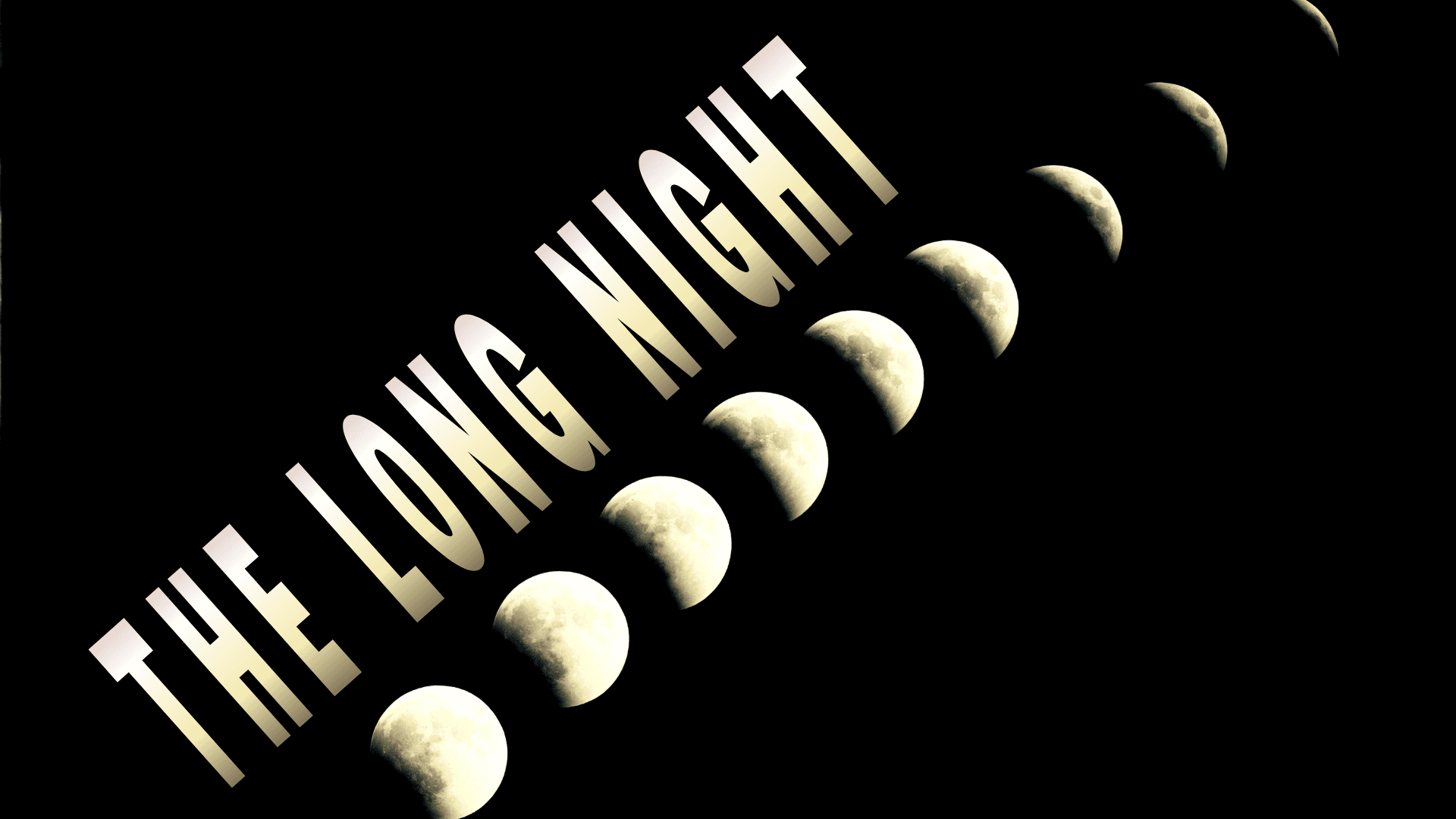
The author, John Pavlovitz, freely acknowledges the paradox: “It might seem strange to start this journey with the end of the story.” But he goes on to point out that we need to know the long night is part of a greater story. We need assurance that dawn is coming.
Speaking for myself, however, I have a lot to learn from long nights before I can get to dawn.
One of my favorite authors, Barbara Brown Taylor, wrote a beautiful, thought-provoking book titled Learning to Walk in the Dark. She begins with our reality: “Eliminating darkness is pretty high on the human agenda—not just physical darkness but also metaphorical darkness.”
She’s right: The darkness of night scares us, and we rush to turn on the light. But she goes on to say, “Learning to walk in the dark … is a spiritual skill some of us could use right now.”
I nod my head, thinking, ‘That’s for sure!’
So when I read the Narrative Lectionary text for this week, which describes the scene of Jesus washing the disciples’ feet at the beginning of his long night’s journey to the cross, I asked myself, ‘What can I learn from Jesus’s long night? Or, to bring it even closer to home, ‘What do I need to learn from my own long nights?’
Love, in the long night
That’s not right!
What was Jesus doing getting down on the floor, washing the feet of his disciples!!! That was the job for servants. Yet, there he was, humbling himself to do work that was usually relegated to the lowest person in the house. There he was, on the long night that would lead to his trial and crucifixion, pouring out love.
It was an act that broke all boundaries. It was striking in its audacity. And, mostly, it was a tangible expression of Jesus’s deep love for this group of people who had walked the journey with him. Before he left them, he wanted them to know how much he loved them.
On this long night, Jesus “loved them to the end” (John 13:1).
On this long night, he told them, “I give you a new commandment, that you love one another” (John 13:34).
It was all about love.
I want to tell you a different story about love during a long night. Not to equate this with Jesus’s long night, but to wrap my head around the idea of “loving them to the end” from my own experience.
The year was 2010, and my mother had started her journey toward dying. She had been transferred from nursing care into hospice care, and we had moved her back to her apartment to prepare for her death.
As we shared memories and tears, we talked about the things my mother would not be here for. One thing she had been looking forward to—she had already started planning her trip!—was the wedding of her first granddaughter, Erin. It was breaking Erin’s heart, knowing that her grandmother wasn’t going to be there. So, with a heart full of love and sadness, this bride-to-be decided to give her grandma a preview.
Erin’s wedding dress had just arrived on Friday, hand-delivered by her sister from Indianapolis where it had been ordered. The next day, Erin’s family asked everyone else to leave for a few hours so they could have some private time with my mom. As they gathered around her bedside that Saturday night, Erin stood on a chair, dressed in full wedding array, so her grandma could see her from a prone position. (At this point, my mom could no longer sit up.) My mom, the quintessential seamstress, was able to whisper to her dear granddaughter, “That’s just beautiful!”
Those were the last words my mom spoke. Fifty hours later, my mom was gone.
In the years since this long night toward my mother’s death, I treasure this memory and the depth of this particular act of love. It makes me realize anew how important it is to tell people—and show them—how much we love them.
How many times have you seen a headline that read something like this? “I kissed my daughter goodbye, not knowing it was the last time I’d ever see her.” The truth is, none of us knows when that might happen.
But I do know, from my vantage point of ever-accumulating years and a few bouts of serious illness, that I am much closer to the edge of life than the beginning. I don’t know how many months or years I will have. While that’s true for any of us, it’s become a visceral reality as I age.
So I remind myself never to postpone love.
Hope, in the long night
That was an awful time!
There’s not one of us who came through the COVID years unscathed. The whole idea of “sheltering in place” may have sounded cozy at first, but as the reality of it set in, our isolation hit hard. We were in for a very long night. We missed being able to do simple things, like shopping or seeing movies or going out to dinner. We missed gathering with friends in homes and churches. We missed hugging those we loved.
We lost a lot. We were scared. We didn’t know what to do or what was coming next. Yet, amazingly, we found we were more resilient and resourceful than we might have expected. We learned how to connect with Zoom calls. We learned how to order groceries online. We learned new ways to reassure people, through calls and mail and prayers, that they (and we) were not alone. I even learned how to cut my own hair!
In other words, we found ways to stay hopeful.
Whenever I find myself in a long night—whether the sun has just gone down or I’m deep into those shadowy, pre-dawn hours—I often turn to music. It helps me feel the steadiness of my heartbeat, the warmth of my tears, and it opens up a tiny bit of hope that daylight is on the horizon. So I want to offer you a bit of the same.
During the long night of COVID, I was working on the staff of a church. We were eight months into our isolation, and we were brainstorming what we might do to help sustain hope. Our Director of Worship & the Arts offered to record some great hymns of our faith and post one each week for what she called an “Uplift Wednesday.” She took particular care to choose hymns by writers/composers who had gone through their own times of suffering or adversity.
I still remember the impact of her singing “Be Ye Still.” I could feel my heart beat slow down and my fears grow quieter. The music and the word were a poignant reminder that God was with me, always. I needed to hold on to this hope, to keep believing in the “I AM God.”
I want to share a short audio clip from the YouTube video:*
Be ye still and know that I am God
Be ye still and filled up with my peace
Be ye still and know that I am the Lord
And be comforted within Me.
—Wendy Carter
Faith, in the long night
That’s not how it happens!
If you, like me, have known dark times in your life, you know how hard it can be to even imagine light will come.
I think of the year I moved from the Midwest to California. The company I worked for was moving to a new office in San Diego, and I had been asked to go out ahead and coordinate the logistics of the move. I felt honored to be asked, and living in California sounded exciting. “California” brought up images of sunny days and blue skies. But getting there was another matter.
First came the hard process of packing up and moving. I remember watching the moving van pull away and feeling scared that I might never again see the things that were important to me. But that was minor, compared to leaving all the people I knew.
The goodbyes were painful. It was hard enough with friends, but with family . . . that hit me way deeper than I had expected. My mother and I had been through multiple rocky patches in my teenage years and early twenties, but she hugged me hard just the same and sobbed when it was time to say goodbye. And I cried halfway across Iowa.
The arrival wasn’t any easier. I remember standing in 30,000 square feet of empty space and feeling terrified that I had agreed to do this. And when a lizard popped up in an empty file drawer, all I wanted to do was turn around and drive right back to the safety of Illinois. It was quite the shock for this dyed-in-the-wool Midwestern girl who had never before seen a lizard “in the wild.”
It took two months of living (actually, more like barely surviving) in an extended-stay hotel room before I could find a place to live and begin to settle in. There were way too many nights when I cried myself to sleep, feeling lonely and regretting my decision to leave what was familiar for what felt like a foreign country.
But, eventually, I found a small cottage to rent in Del Mar, a couple of blocks from the ocean. I started walking the cliffs above the beach and watching sunrises and sunsets. I relished standing there feeling awed at the power of massive waves rolling in. And my first sighting of dolphins playing in the surf had me grinning from ear to ear. Wow!
Dawn had finally come for me.
The point is—and the point I think Pavlovitz is making in his Lenten devotional—in our darkest nights, we need to hold on to the belief that dawn is possible.
Even—and maybe especially—in our fear about what’s going to happen to us if we’re entering a new phase in life.
Even—and maybe especially—in our grief when friends or loved ones die.
Even—and maybe especially—right now, in these scary days of unrest and uncertainty.
During these long days, nights, weeks, months, we need to hold on to—and hold out—the promise of dawn. We may want an instant sunrise, something like flipping a light switch so the dark room becomes bright. But that’s now how it happens.
I know there are many long nights ahead of us. There’s the waiting, the wailing; there’s the praying, the protests. But there’s also having faith that dawn will come. And when it does, slowly peeking up, bit-by-tiny-bit, on the horizon, we won’t know what the new day will bring. But we can trust that Jesus will “love us to the end.”
Julian of Norwich’s familiar quote comes to mind: “All shall be well.” If we take these words to mean “things will turn out all right in the end,” it suggests that there will be no more suffering or pain.**
I believe there’s something deeper to learn here.
There’s a poem by British author Ann Lewin titled “Dark Moments” that sheds some light on my understanding of Julian’s words:
The courage that says
‘All shall be well’
Doesn’t mean feeling no fear,
But facing it, trusting
God won’t let go.
‘All shall be well’
Doesn’t deny present experience
But roots it deep
In the faithfulness of God,
Whose will and gift is life.
—Ann Lewin, excerpt from “Dark Moments,” Watching for the Kingfisher: Poems and Prayers
For me, this is probably the most important lesson from the long night: keeping faith that God will not let go. That God will “love us to the end.”
I know scripture tells us, “And now faith, hope, and love remain, these three, and the greatest of these is love” (1 Cor 13:13). But I’ll be blunt: For me, right now, my greatest need is faith. I need to keep on believing that God is with us. I need to have faith that “all will be well.”
—Marcia Broucek, graphic designer for Narrative Alive
I welcome your comments about my reflections. If you have anything you want to share about your journey, I invite you to share your experience in the Comments field below.
= = = = = =
* This recording of “Be Ye Still” was made during the COVID epidemic by Kristin Young, Director of Worship & the Arts, St. Mark’s Lutheran Church, Aurora, IL. Click here to watch the full YouTube video.
** I want to credit The Rt Revd Graham James, Bishop of Norwich, in his 2012 Julian Festival Address, for guiding my thoughts about Julian of Norwich.
All scripture quotations, unless otherwise noted, are from the New Revised Standard Version Updated Edition. Copyright © 2021 National Council of Churches of Christ in the United States of America. Used by permission. All rights reserved worldwide.
Click here to read more of Marcia’s blog posts.
Click here to see the Narrative Alive graphics and sermon themes for the Narrative Lectionary reading “Jesus Washes Feet.”
Gary Schulstad says:
Julian of Norwich’s “All Shall Be Well’ has been a long-time favorite of mine. Peter Townshend of the Who wrote it in his song of the same name. He wrote it after a terrifying dream, to reassure himself.
Marcia Broucek says:
I just listened to Peter Townshend’s song. I loved the way he kept repeating the refrain “All shall be well.” Thanks for introducing me to this music.