
The Beauty of Brokenness

We’ve all been there
Who, me??? I’d never do that!
I’d never make promises I couldn’t keep, like Peter telling Jesus, “I will lay down my life for you” and then turning his back.
I’d never disown a friend, like Peter denying he even knew Jesus.
I’d never be afraid to stand up for someone I love.
But if I think of Peter as more of an archetype of human behavior, I have to come face-to-face with the truth: I am Peter, at a core level.
Maybe my actions are not Peter’s, but I share his human frailties. After all, I am human. And we humans do come with flaws.
Peter was probably scared out of his wits during Jesus’s trial: “What’s going to happen to me? What’s going to happen to my friend?”
I know that fear.
Peter likely felt abandoned: “How can I go on without you?”
I know that loss.
Peter might have felt angry: “But I believed in you! I trusted you!”
I know that anger.
Peter surely felt alone: “After all I’ve been through with you, you’re leaving me?”
I know that despair.
Peter probably felt as if all his hopes and dreams for the future were shattered: “Were all those days, months, years of being your disciple for nothing?”
I know that pain.
We’ve all been there, one way or another. Probably not in such a dramatic fashion as Peter, or against such a crucial background, but in the smaller moments when we blurted out something or did something rash. Sometimes our regret is immediate: I can’t believe I just said that! I can’t believe I just did that! Sometimes it hits us later: I’m so sorry I said that. I wish I could undo that.
The events of Peter’s denial, as recorded in Scripture, are pretty obvious. What’s not so obvious is what Peter might have felt. We can well imagine he was afraid. Who wouldn’t be! But what about afterward?
Guilty?
Ashamed?
Alone?
I wonder: Did Peter feel crushed by what he had just done? Did he feel broken?
Are we broken?
I’m going to tell you three stories from three different eras of my life. Not because they’re “big” stories, but because they help me recognize the threads that weave through my life which link me with this man who lived 2,000 years ago—and with every other person who has walked on this planet.
______
Like Peter, I know about feeling guilty.
You’d think by now, at my age, I wouldn’t be remembering something that happened seventy years ago. But there it is. Every once in a while, out of the blue, I feel a pang of guilt about what I did back then.
My memory is this: I was probably around seven or eight and staying at my grandma’s house. She had asked me to walk up to the corner store to get something she needed for dinner. She had ordered it ahead and told the grocer I was coming. (Yes, those were the days when you knew the grocer and a kid could walk to the corner store.)
All went well, at first. I got to the store, got the item, got the change from the money my grandma had sent with me. But I also got something else: I used some of the change to buy myself some candy.
When I got back to my grandma’s house, she counted the change and knew it wasn’t enough. When she asked me about it, I flat out lied and told her that was what the grocer had given me. But as she probed more (she apparently knew the grocer would never shortchange her), I confessed what I had done.
She immediately put on her coat and marched me back to the store to apologize to the grocer for my lying, for blaming him. My guilt from that day must have buried itself deep in my bones because twinges of that memory sometimes still surface unexpectedly.
______
Like Peter, I know about feeling ashamed.
Those of you with perfectionist tendencies like me might relate to this story.
I was a book editor for many years, but one incident sticks out larger than life. I had sent an author a copy of her manuscript with some editorial suggestions and grammatical corrections. But she came back to me and pointed out that one of my corrections was not correct.
I could feel my face burning and my heart sinking. How could that have happened! I looked up the grammatical issue at hand, and sure enough, the author was right. I, who was supposed to be the editor, the “expert” at this stuff, had been wrong.
I never forgot the grammar issue I learned that day, but apparently I’ve also never forgotten the shame of that moment. I think these words of Bishop Meghan Johnston Aelabouni pretty much sums it up:
Many of us freely acknowledge that nobody’s perfect — and then we turn around and try our hardest to be perfect, and feel guilt and shame when we inevitably fail.
—Meghan Johnston Aelabouni, “Perfectly Imperfect,” from ELCA’s Bold Café
______
Like Peter, I know about feeling afraid.
I’ll tell you what wakes me up in the middle of the night: I’m afraid of not being able to take care of myself as I get older. I’m not afraid of dying, but I’m afraid of being helpless, of needing to depend on someone else.
As a single woman with no children, I always knew it would be up to me to make a plan for this stage of my life. But now this is no longer something on the distant horizon, and I’m realizing making a plan is more difficult than I had imagined.
There are so many things to consider. Do I move to a place with independent living that also provides additional care when I need it? How important is it to me to live near my sisters? What kind of “atmosphere” am I looking for? And—the big one—what will it cost? Do I have enough money?
I had come to the conclusion that a “CCRC” (Continuing Care Retirement Community) would be best for me because these facilities offer a continuum of care, from independent living, to assisted living, to skilled nursing. Once you were in, they would take care of you for the rest of your life. I longed for that reassurance. I needed to know that the burden of care would never fall on my brothers and sisters. So I did my diligent scouting and found a place I fell in love with. Low key atmosphere with clean lines (I cringed at places that had dated decor and fussy furniture), flexible meals, and some nice amenities. I had already met a few people with whom I knew I could have long discussions, and I looked forward to watching sunsets from my apartment balcony.
But it was not to be. At least not for now. After all my careful saving and planning, their financial gurus determined I didn’t have enough money for them to consider me for a lifetime residency. What a blow.
Until I heard that news, I don’t think I realized how afraid I really was, because when they told me I couldn’t get in, I couldn’t stop sobbing. My raw fear of ‘what will happen to me’ overwhelmed me, and I fell into the hole of feeling alone.
So, yes, I/we know the full human range of emotions that shift from fear, to shame, to guilt, and back again. But the greater question is this: Are we more than our fears, our shortcomings, our screw ups? Do we know we have value despite our brokenness? What if we have value because of our brokenness?
Are we beautiful?
The stark reality of the biblical story is that Peter said “I am not” three times, as he stood in that courtyard.
But the beautiful reality is that Jesus had said “I AM” three times the night before, when he had been arrested in the garden (John 18:1-8).
And the beautiful gift is that Jesus never stopped believing in Peter. When Jesus appeared on the beach after his death and resurrection, he asked Peter, three times, “Do you love me?” Each time, Peter said “I do” (John 21:9-19).
Jesus didn’t see Peter’s “brokenness”; Jesus saw Peter’s possibilities as leader of the church.
One of the most beautiful images I know about this way of seeing is the Japanese art of kintsugi. Kintsugi, meaning “to join with gold,” is a 500-year-old technique of mending broken pottery using lacquer mixed with powdered gold. But it’s much more than just mending. The mended flaws become part of the design, and the pottery is believed to be even more beautiful for having been broken and repaired.
Based on the Japanese philosophy of wabi-sabi, which calls for seeing beauty in the flawed or imperfect, the kintsugi technique highlights what some might consider “scars” and creates something more unique, more beautiful, more resilient.
I think Jesus is a kintsugi master.
Jesus’s I AM sees our beauty in the cracks. He sees our brokenness and loves us all the more. He changes our narrow beliefs about ourselves into truths that make us whole:
- “I am broken” becomes “You are valuable”
- “I am alone” becomes “I will help you.”
- “I am afraid” becomes “Fear not; I am with you.”
There’s a poignant story in another one of Bishop Meghan’s articles, “Beyond perfection,” that captures the essence of this. She tells about a time when she overheard her six-year-old daughter muttering, “I hate myself! Stupid Natalie!” That night, when Meghan put Natalie to bed, this is what she told her daughter:
“…even when you aren’t perfect and you make mistakes, I would never in a million years trade you for anyone else, because who you are is amazing. I want you to know that God loves you too, no matter what, and so do I. And even when you aren’t perfect and you make mistakes, I would never in a million years trade you for anyone else, because who you are is amazing.”
—Meghan Johnston Aelabouni, “Beyond Perfection,” from ELCA’s Bold Café
“Who you are is amazing.”
Those words are hard for me to believe when I am disappointed in or disapproving of myself. But more and more—especially as I look back over my younger years from the perspective of age—I am coming to understand Richard Rohr’s idea that “everything belongs”—even the broken parts of me, the mended parts. *
But it’s more than just “accepting” my flaws and limitations; it’s embracing the idea that the parts of me that got hurt or cracked or crushed over the years have, in fact, made me who I am. They are part of me, they belong.
Like a kintsugi bowl, I am more beautiful for having been broken. And God loves me for who I am, for all of who I am.
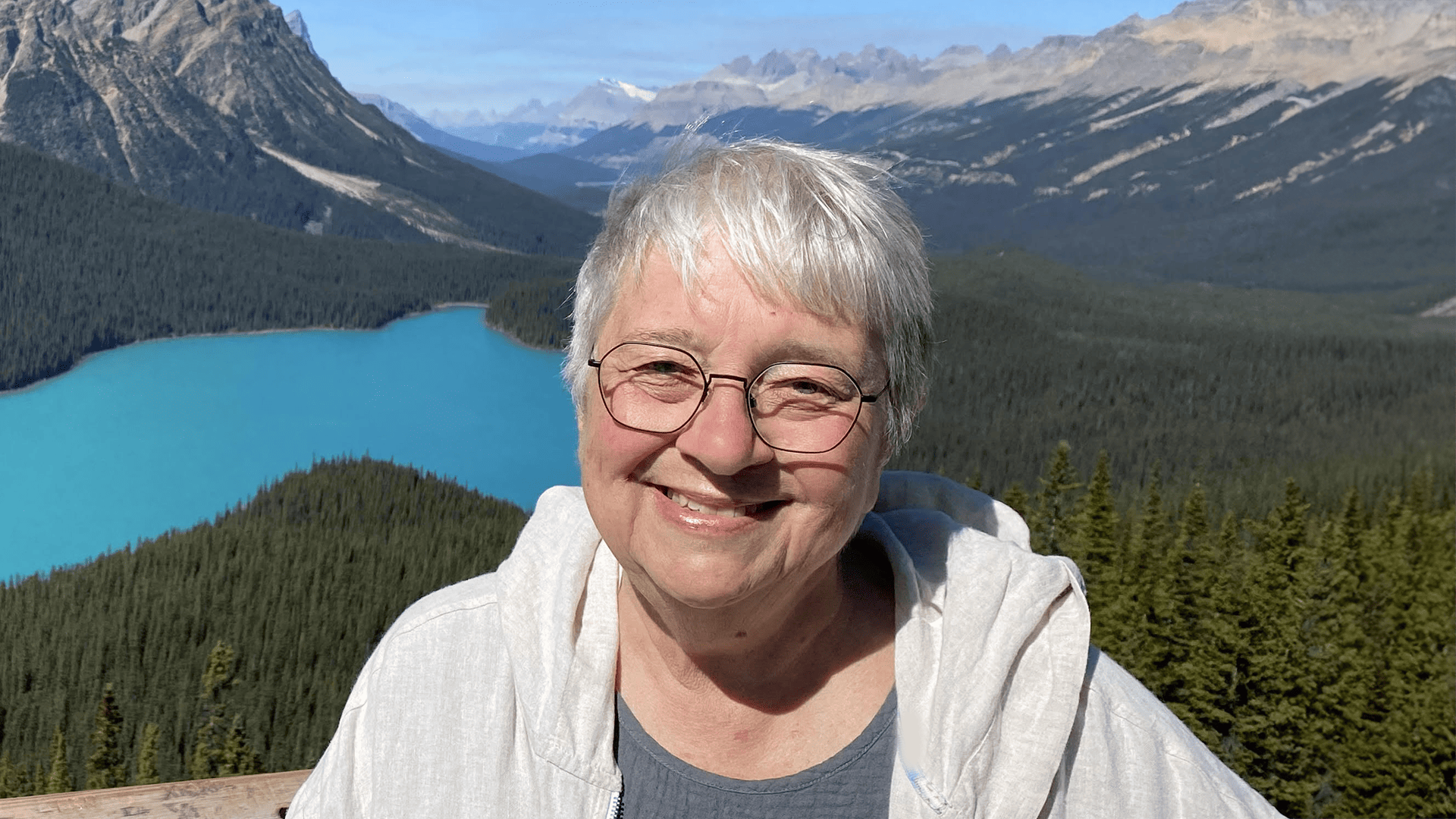
—Marcia Broucek, graphic designer for Narrative Alive
I welcome your comments about my reflections. If you have anything you want to share about your journey, I invite you to share your experience in the Comments field below.
======
*Reading Richard Rohr’s book Everything Belongs: The Gift of Contemplative Prayer has been and continues to be an important part of my journey.
Click here to read more of Marcia’s blog posts.
Click here to see the Narrative Alive graphics and sermon themes for the Narrative Lectionary reading “Peter’s Denial.”
All scripture quotations, unless otherwise noted, are from the New Revised Standard Version Updated Edition. Copyright © 2021 National Council of Churches of Christ in the United States of America. Used by permission. All rights reserved worldwide.